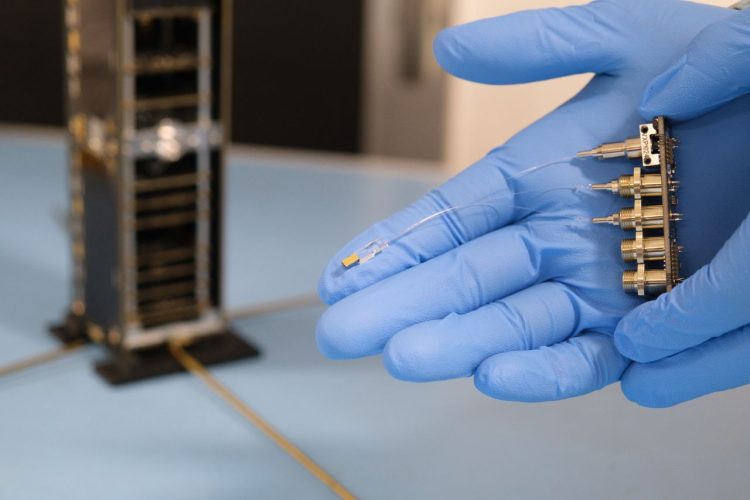
SME4SPACE member LioniX International – building on its experience in photonic integrated curcuits, MEMS, and microfluidics – is developing the integrated photonic technology needed for the next generation of compact life detection instruments in the Life Marker Chip.
This technology is being further developed for future missions that could search for signs of life in ocean worlds such as Enceladus, one of Saturn’s moons. The photonic chip at the heart of this programme will be tested in space for the first time, as part of an upcoming TU Delft PocketQube mission. This mission is supported by the Netherlands Space Agency (NLSA). At the center of this chip? PRISM: the PocketQube Refractive Index Sensing Module developed to detect molecules by measuring small changes in the refractive index of liquids.
Being among the first demonstrations of the Dutch silicon nitride photnic chip TriPleX, it will fly on the Delfi programme platform. With Delfi and PRISM, TU Delft demonstrates how research can move from laboratory concept to space-based validation using in-house expertise and national partnerships. The launch, currently planned for early 2027, will mark the next milestone.
Read more on LioniX’s website here.